
Introduction
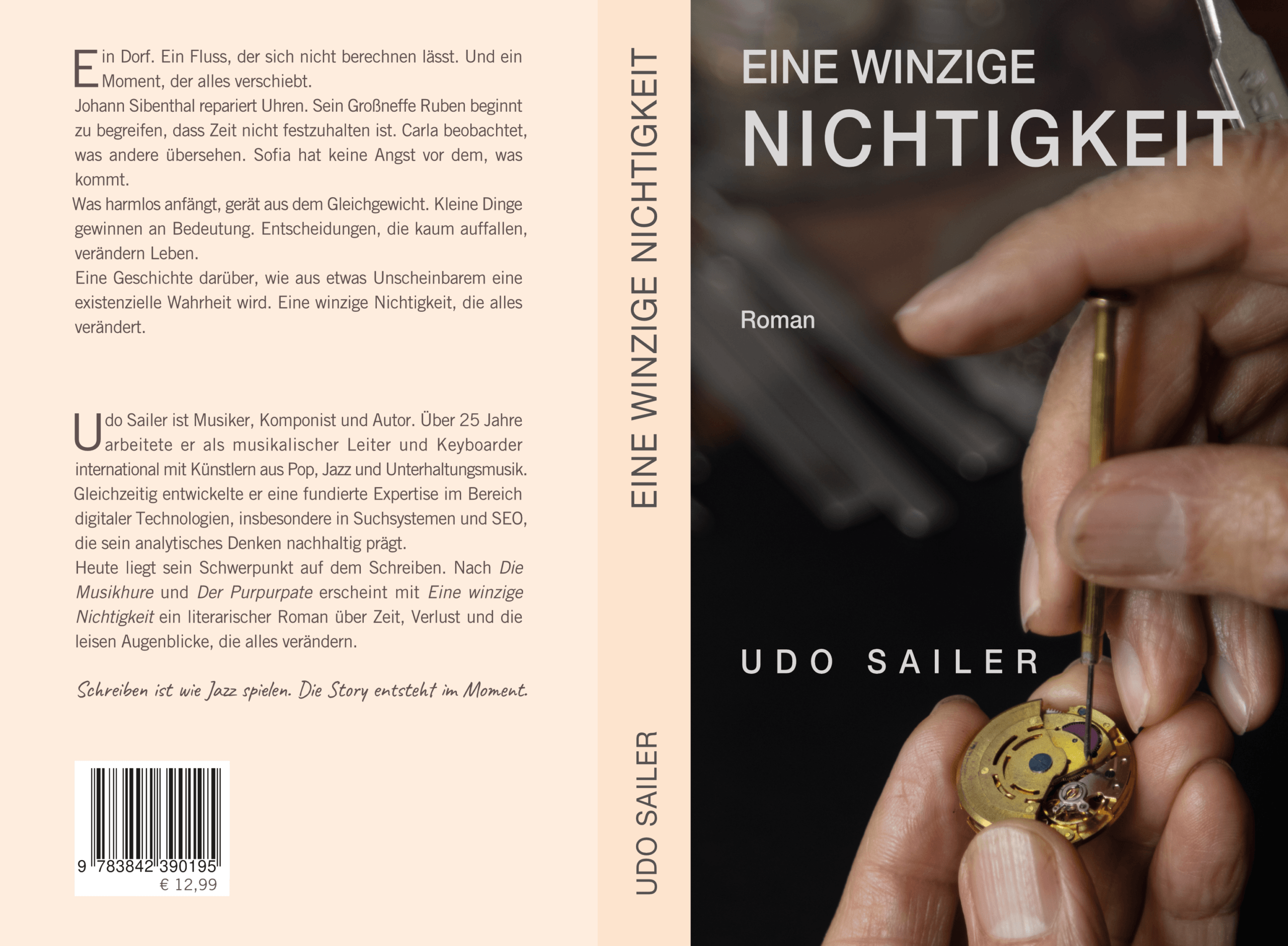
In *A Tiny Nothingness*, musician and author Udo Sailer presents a contemporary novel set in a small village on the banks of an unpredictable river—amidst a watchmaker’s workshop, a children’s hospice, and the town square. The story centers on the reserved watchmaker Johann Sibenthal, his great-nephew Ruben, the observant Carla, her friend Lina, and the cat Mrs. Stolzenberg.
Description
Mr. Sibenthal repairs watches—and, it seems, sometimes time itself. During a “historic signing,” he stops the town hall clock’s pendulum for seven seconds: a tiny shift that imperceptibly throws routines, relationships, and habits off balance. Ruben, who has been silent for a year, finds refuge in Sibenthal’s workshop; Carla records everything with her voice recorder; Mrs. Stolzenberg, the cat, always shows up wherever someone needs protection. When a letter reveals that Ruben’s father Étienne, believed to be dead, is alive and returning, and the river threatens the slope beneath the hospice after heavy rains, it becomes clear: apparent trifles—a pen, a screw, the barely audible scratching of a quill, legally “a tiny nothingness”—can determine life and loss.
Thematic Context
“A Tiny Nothingness” explores themes that are particularly relevant in our fast-paced present: climate risks and flooding, the pressure to function constantly, hospice and palliative care as a space for good days rather than mere farewells, questions of guilt and responsibility, as well as those of origin, exile, and dual identity. With a subtle touch of magical realism—the watchmaker’s interventions remain technically explainable yet symbolically charged—the novel blends coming-of-age, family history, and village fiction. Recurring motifs such as clocks, the tolling of bells, water, and cracks—in walls as well as in biographies—come together to form a poetic study of vulnerability, responsibility, and resilience.
Target Audience Note
The novel is suitable for young adultsaged approximately12–16 as well as for adult readersinterestedin topics such as mindfulness,the perception of time, hospice care, rural areas in transition, and family andgenerational conflicts.
I'm really looking forward to reading the book. Where can I buy it?
Available at bookstores everywhere.
Is the book available on Amazon?
Yes, but also at other bookstores. Thalia, Osiander, Hugendubel, etc.
As precise as clockwork, as poetic as jazz
You can tell from this novel that the author is a musician. The text is structured rhythmically: pauses, entries, delays—as in the chapter about the concert in the church, when a cat throws the second movement “off-beat” and, precisely because of that, brings everything back into balance. Formally, I’m drawn to the polyphony of perspectives: the wise old clockmaker Sibenthal, the curious Carla, the taciturn Ruben, the controlling mayor, even the “Insta-family” Hoffmeister with their marbles. It’s always about time and tiny interventions: seven seconds on the town hall clock, a piece of felt on the bell, a packet of marbles, an alarm clock rental during a power outage. Stylistically unadorned, yet highly precise and full of subtle meaning. For readers who appreciate intelligent, understated literature.
A tender story about time, courage, and a girl with a red scarf
This book left me speechless. Through calm, precise scenes, the author tells the story of a village where an old clockmaker, Mr. Sibenthal, quietly shapes the passage of time in the background. I was particularly moved by the chapters about Sofia at the children’s hospice: her red scarf, the bench by the river, the broken clockwork that “still runs,” and her inner monologue in the “amusement park in her head”. Carla, as the observing first-person narrator, and Ruben, with his almost uncanny chess-like gaze, lend depth to the whole. The writing style is quiet, rich in imagery, and free of kitsch—sentences like “Laughter isn’t medicine. But sometimes it lasts longer than morphine” linger. A quiet, powerful book.
Emotional, without being cheesy
I read the last few chapters almost in one sitting, and I had tears in my eyes several times. The scene in Sibenthal’s workshop, when Ruben speaks again for the first time (“I… think… so”), really moved me. You can feel all the tension in that single sentence. Later, when children laugh at the hospice while the clock ticks quietly inside and the chapel bell rings, an atmosphere of both sorrow and hope emerges. I also loved how Carla struggles with her empty notebook; some things just don’t belong on paper. The writing style is simple but full of imagery, never cheesy. A book that stays with you long after you’ve closed it.
A wonderfully relaxing experience
“A Tiny Nothingness” thrives on atmosphere. You can smell Mr. Sibenthal’s workshop, hear the ticking of the clocks, and see Mrs. Stolzenberg striding across the workbench. The most powerful moments are the very concrete ones: Ruben, who utters a single word after a long silence; the chapel bell, which becomes “softer” with a piece of felt and suddenly changes everyday life in the village; the power outage during which everyone meets again. The writing style is finely observant, almost minimalist magical realism. However, one must be willing to engage with a narrative that takes its time and is rich in nuance.
A quiet masterpiece—as precise as clockwork
Literarily, this book surpasses much of what is currently being celebrated in German-language literary pages. The author works with recurring motifs that run subtly throughout the text: the notebook that is never fully written in; the clock that “keeps ticking for everyone”; the bell whose sound fills the valley; and Mrs. Stolzenberg’s cat, a silent witness in key scenes. Leitmotifs such as time/clocks and water/river permeate every level—from Sofia’s silent pendulum clock to the rising floodwaters. Formally impressive is how a landslide becomes not a disaster novel, but a reflection on responsibility. Ruben’s great deed, Étienne’s gesture with the medal—all of this is imbued with quiet, unsentimental dignity. Great literature that manages without pathos and yet touches the reader deeply
.
Anyone who has experienced flooding will recognize many of these things
What struck me most of all was the atmosphere. The description of the old hospice in the water, the warped cellar door, the musty smell, and later the new house with a crack in the south wall—it’s painfully realistic. I know all too well that feeling of constantly checking whether the slope will hold, whether the river will stay calm. I found the portrayal of community particularly moving: Ruben, who carves “This was home” into the oak plank; Therese with her quiet courage; Isabell, torn between closeness and distance from Étienne. Death is portrayed without pathos, which is precisely why it hits so close to home. The fact that, in the end, Ruben’s bell remains without a clapper and only the grandfather clock ticks is a powerful image: Life
goes on, but differently. An important, comforting book.
Sailer tells the story with a calmness that is almost defiant in our fast-paced times. The scene of the “historic signing,” in which Sibenthal holds the town hall clock’s pendulum a few
seconds too long, is masterfully constructed: cameras, ministers, the mayor—and then that intense silence in which suddenly nothing is being signed anymore. The novel consistently focuses on small shifts: the repaired music box, the muffled chapel bell, a cat that brings an entire orchestra to a halt. I particularly liked Carla as a young observer who registers everything but cannot yet make sense of it. The style is clear, concise, without kitsch—and precisely because of that, very poetic. A quiet, intelligent book.